How to Select T200 Lifting Machine for a Meat Processing Line
A practical engineering guide for evaluating equipment, process interfaces, sanitation, utilities and line capacity before purchase.
Selecting meat-processing equipment is easier when the decision starts with the product and process rather than the machine name. The same general category can be used in very different plants, and apparently similar machines may have different capacity, working geometry, utilities or interfaces. This guide uses T200 Lifting Machine as the central example and explains how buyers can translate a production requirement into a specification that is easier to quote, install and operate.
The supplied catalogue provides concrete technical reference data for the equipment family. Those values are useful because they anchor the discussion in model-specific facts. At the same time, catalogue numbers do not describe every part of a real production environment. Product temperature, casing behavior, raw-material consistency, operator method, upstream supply and downstream accumulation all influence the result. A good purchasing specification combines both: documented machine parameters and clearly described plant conditions.
1. Start With the Product Requirement
Write down the product in operational terms. For sausage equipment, include casing type, casing diameter, portion length, filling consistency and whether the product is linked, tied, clipped or hung. For frozen-meat cutting equipment, include block dimensions, inlet temperature and required cut geometry. For mixers, injectors and tumblers, include batch weight, recipe characteristics, expected residence time and the process result that must be repeatable.
This information prevents a common mistake: choosing equipment on capacity alone. A machine may have adequate nominal output but an incompatible product-size range. A cutter may be fast enough but not accept the raw-material geometry. A filling machine may have sufficient power but not match the required casing. A smokehouse may have enough chamber capacity but require utility conditions that are not available in the plant. The selection should therefore start with the narrowest process constraint.
2. Read Technical Tables as a System
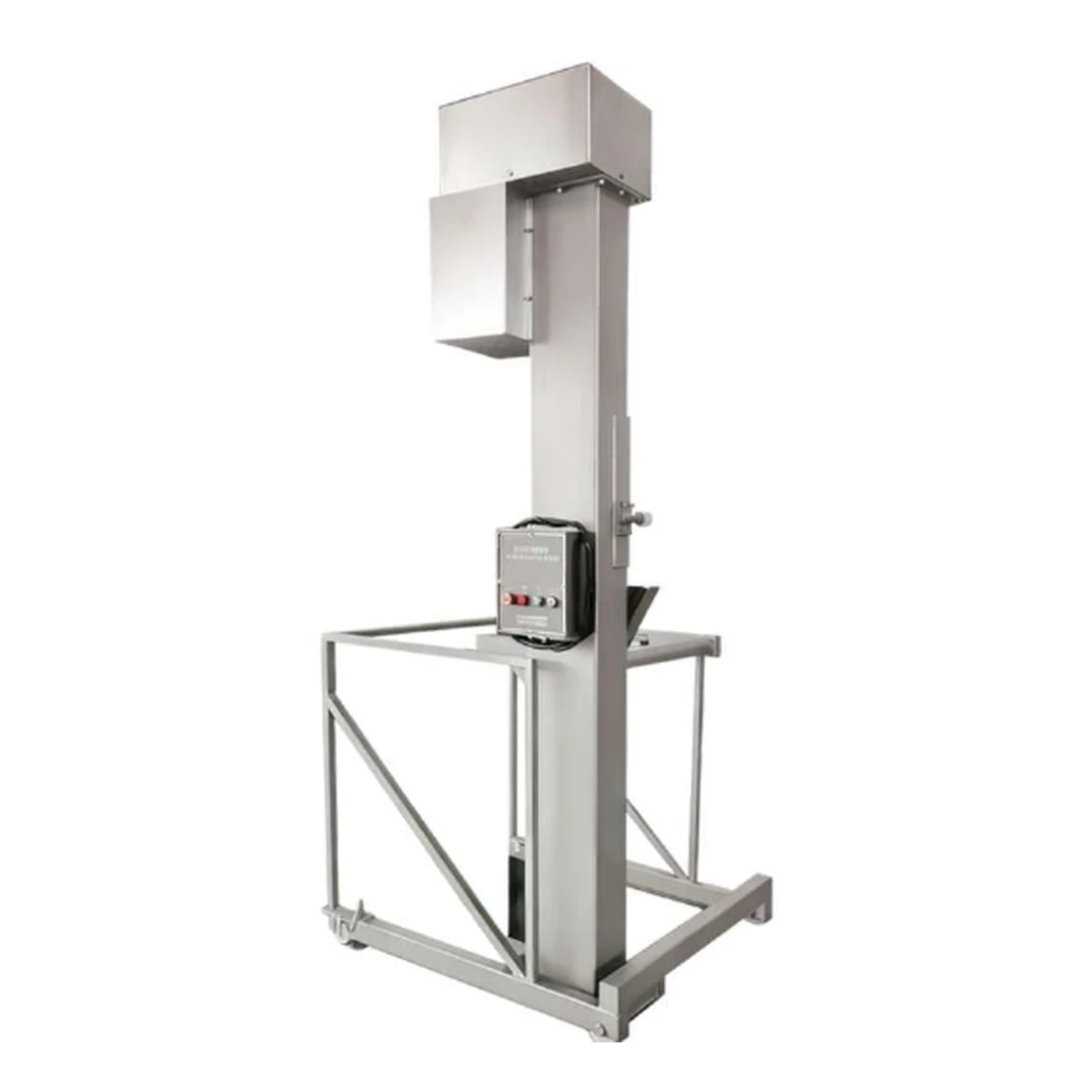
| Modello | T200 |
| Weight | 200 kg |
| Lifting height | Standard 1.8 m; customizable |
| Lifting speed | 3 m/min |
| Motor power | 1.5 kW |
| Dimension | 920 × 1100 × 2800 mm |
Each row in a technical table affects another decision. Capacity affects upstream feeding and downstream handling. Power affects electrical planning. Machine dimensions affect floor layout and maintenance access. Speed ranges influence synchronization. Working pressure, vacuum level or temperature affects utility design. Weight matters for floor loading and installation handling. The model code ties those values together; never transfer a value from a nearby model just because the photographs look similar.
For an RFQ, copy the exact model or family name and list the parameters that matter to the application. If a value is not stated in the source material, mark it for confirmation. This is safer than filling the gap with an assumption, and it gives the supplier a clear question to answer on the final quotation or drawing.
3. Balance the Complete Production Line
A meat-processing line performs only as well as its slowest practical stage. That stage is not always the machine with the lowest nameplate capacity. Manual loading, product preparation, sanitation breaks, accumulation limits and changeovers can reduce effective output. When the line contains fillers, clippers, hanging equipment, cutters, mixers or material-handling devices, establish a common production target and estimate the real cycle for each step.
Continuous systems need a buffer strategy. If upstream product continues to arrive while a downstream machine stops, determine where material can safely wait without compromising process control. Batch systems need a sequencing strategy. A mixer or tumbler may complete a batch, but the next machine must be ready to receive it. Otherwise, the nominal batch capacity does not translate into a stable hourly rate.
4. Check Utilities Before the Layout Is Frozen
Electrical voltage and frequency should be confirmed against the installation country and plant distribution. Pneumatic machines need adequate pressure at the point of use, not only at the compressor. Vacuum machines need a stable vacuum system and sound seals. Smokehouses and heat-treatment equipment can require steam, heating and exhaust provisions. Utility piping and cable routes should be planned before the final equipment location is fixed because service access can be blocked by walls, drains or adjacent machines.
Do not forget cleaning utilities. Wash-water access, drainage direction and splash control influence daily sanitation time. If the machine includes removable blades, needles, clips, paddles, drums, guards or trolleys, provide space for safe removal and cleaning. A layout that fits the machine but leaves no service space usually creates avoidable production problems later.
5. Sanitation and Product-Contact Review
The supplied equipment literature emphasizes stainless-steel construction across many machines in the range. During project review, identify exactly which components contact product and how they are cleaned. Smooth visible surfaces are helpful, but sanitation planning should also cover joints, seals, fasteners, hidden corners, drains and removable assemblies. Ask how normal product residue is removed and how an operator can visually verify the result.
For cutting and grinding equipment, tool condition is part of sanitation and product quality. For injectors, needle cleaning and blockage prevention matter. For fillers and clippers, the product path and closure area require attention. For mixers and tumblers, seals, doors and internal paddles or guide plates should be included in the cleaning procedure. A useful sanitation plan assigns a method, frequency and inspection point to each area.
6. Make the RFQ Specific Enough to Compare Offers
- Product type, recipe or raw-material condition.
- Required throughput, batch size or pieces per minute.
- Product-size range, casing range, cut geometry or portion target.
- Available voltage, frequency, compressed air, vacuum, steam and exhaust as applicable.
- Feed height, discharge direction, available floor area and interface with existing machines.
- Required documentation, spare parts and commissioning expectations.
When every supplier receives the same technical requirement, quotations become easier to compare. Differences can then be discussed as real configuration choices rather than hidden assumptions. This also helps the final purchase order repeat the agreed model, options and utilities accurately.
7. Commissioning and Acceptance
Define the acceptance method before the machine arrives. Identify the test product, starting condition, batch or run length, target throughput and the quality observations that will be recorded. If speed is adjustable, state the test setting. If several product formats are important, decide which ones must be demonstrated. Acceptance is more useful when it reproduces the intended production condition rather than a short empty run.
During commissioning, verify utility stability, motor direction, safety devices, guards, controls, feed and discharge movement and cleaning access. Record the final settings that produce an acceptable result. Those settings become a useful baseline for operator training and troubleshooting.
8. Maintenance Planning
Create a preventive-maintenance list around the actual wear points. Cutting tools, seals, bearings, vacuum components, pneumatic cylinders, clips, needles, chains, reducers and sensors do not share the same service interval. Inspection frequency should consider operating hours, load, washdown exposure and the cost of an unplanned stop. Critical spare parts should be identified before production starts so the line is not dependent on emergency shipping for a predictable wear item.
Maintenance records are also useful for process control. If cut quality, portion repeatability, vacuum performance or closure quality begins to drift, the cause may be wear rather than a recipe problem. Recording the date, setting and replaced part makes that pattern easier to recognize.
9. Questions Buyers Commonly Ask
Should the largest model always be selected?
No. Select the model that fits the real product range, utilities and line balance. Oversizing can increase cost and footprint without improving practical output.
Can catalogue capacity be used as final guaranteed throughput?
Use it as a documented machine reference. Final throughput should be confirmed for the intended product and operating condition.
What if a required parameter is not shown?
List it as an RFQ confirmation item. Do not substitute a number from another model or a similar machine.
Why is layout information needed so early?
Because access, feed direction, carts, trolleys, cleaning, drains and service space can change which configuration is practical.
What is the best way to shorten quotation time?
Send the product, capacity, utilities, size range and layout information together. A complete RFQ reduces repeated clarification and helps keep the final configuration traceable.
10. Final Selection Principle
The most dependable selection is the one that connects a documented machine model to a documented production requirement. For T200 Lifting Machine, use the source-confirmed table on this page as the technical starting point, then add the conditions that the catalogue cannot know: your product, utilities, building layout, sanitation method and line interfaces. That combination gives engineering, purchasing and operations a common basis for the decision.